
Elevated hs-CRP vs Fascial Counterstrain
For years, I tried almost everything I could think of to lower my inflammation.
I changed my diet, supplements, exercise, sleep and other lifestyle factors. I also used ozone therapies, including major autohemotherapy and injections.
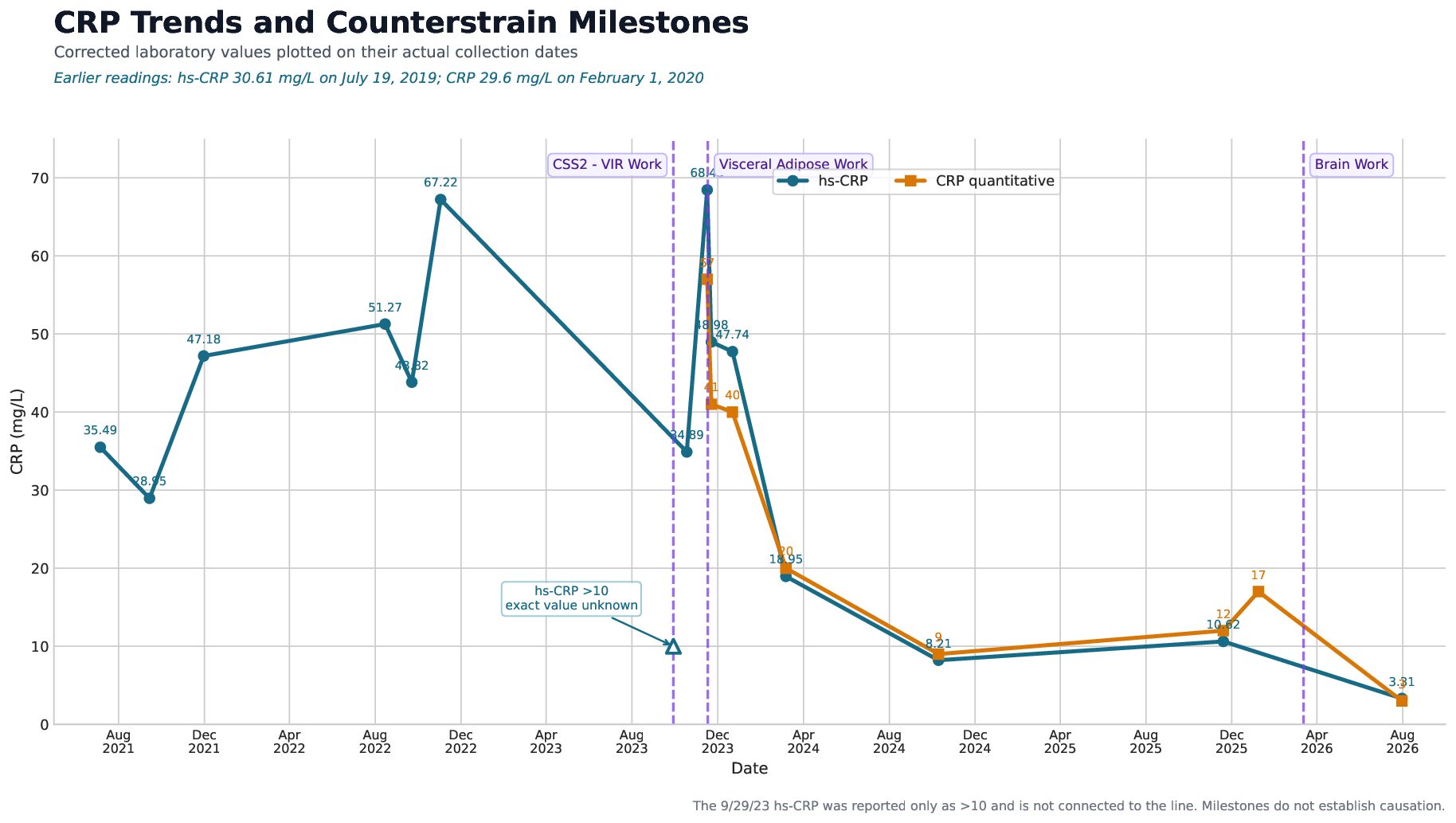
Yet my hs-CRP remained persistently high and highly variable:
• 30.61 mg/L in 2019
• Between 28.95 and 47.18 mg/L in 2021
• Between 43.82 and 67.22 mg/L in 2022
• A peak of 68.45 mg/L in November 2023
During this period, I received Counterstrain work involving three systems connected to inflammatory and metabolic regulation:
• The vagus inflammatory reflex, which helps the nervous system detect inflammatory signals and regulate immune activity
• Visceral adipose tissue, which is metabolically active and contains immune cells capable of contributing to systemic inflammation
• The arcuate nucleus of the hypothalamus, which integrates signals involving insulin, leptin, energy balance and autonomic regulation. It is also one of several brain regions involved in the effects of GLP-1 receptor agonists.
The timing does not implicate all three interventions equally.
My hs-CRP was reported only as greater than 10 on the day of the VIR work. Because the laboratory did not provide an exact value, I cannot determine whether the subsequent result represented an increase or decrease.
The clearest immediate measured change followed the visceral adipose work.
One day before that class:
• hs-CRP was 68.45
• Regular CRP was 57
Five days afterward:
• hs-CRP had fallen to 48.98
• Regular CRP had fallen to 41
Both markers decreased by approximately 28%.
The values remained lower one month later and continued declining:
• March 2024: hs-CRP 18.95
• October 2024: hs-CRP 8.21
• July 2026: hs-CRP 3.31 and regular CRP 3
My latest hs-CRP represents a 95.2% reduction from its peak.
A further decline also followed later brain-focused work, but the laboratory measurements were months apart, so I cannot isolate its effect.
Does any of this prove that Counterstrain caused the improvement? Not Necessarily.
CRP is a nonspecific inflammatory marker. Acute illness, body composition, medications, sleep, exercise and many other variables can affect it. The November 2023 peak may also have represented an acute inflammatory spike followed by some natural regression.
What I can say is that, after years of persistently elevated CRP, the first closely measured decline occurred within five days of the visceral adipose work and was followed by a sustained downward trend.
That temporal association is not proof, but I believe it is worth documenting and investigating.
Could unresolved dysfunction within nervous, vascular, visceral or metabolic regulatory systems help maintain inflammation in some people?
I plan to continue following my laboratory markers and exploring that question.
To your resilience,
Dr. Evan van Driel, ND
True Resilience Integrative Medical Solutions